
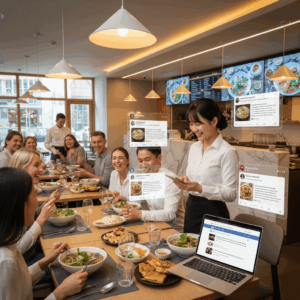
The service industry, such as restaurants, salons, and spas in Germany, is changing faster than ever, driven by new consumer behaviors, modern technologies, and increasingly strict regulatory policies.
These changes not only affect how businesses operate but also reshape the entire customer experience—from how they make reservations and payments to how they share their experiences on social media.
To adapt to this new context, understanding and practically applying technological trends is crucial. Businesses that leverage digital tools, automation, and data early on can optimize costs while creating superior customer experiences—all key factors for maintaining a competitive edge in a highly dynamic market.
1. Digital Ordering & Contactless Payments
Digital experiences are increasingly prevalent in the food service sector: mobile reservations, QR code menus, and cashless payments.
Modern restaurants have integrated online ordering apps that allow customers to order and pay with just a few taps. Results include:
-
15% reduction in waiting time for orders,
-
20% increase in order accuracy,
-
Significant improvement in customer satisfaction.
For restaurant owners, this not only reduces the workload for staff but also generates valuable data—tracking ordering habits, peak times, and table performance. However, it is crucial that the system is fully synchronized with POS and payment gateways to avoid operational disruptions. Many restaurants in Berlin and Frankfurt now consider QR menus and app payments a standard requirement rather than an optional feature.
2. Data-Driven Personalization
Customer data is becoming a new competitive weapon in the service industry.
By analyzing data from past orders, visit frequency, or online reviews, restaurants can send personalized offers, suggest dishes matching customer preferences, and even predict needs before they are requested.
For example, a coffee chain in Hamburg implemented AI-based recommendations based on purchase history, resulting in a 10% increase in repeat visits and a 12% rise in average revenue per order.
However, strict compliance with data protection regulations (GDPR) is critical. Transparently communicating how customer information is collected, stored, and used builds trust and a reliable brand image—something German consumers value highly.
3. Supply Chain Optimization through Technology
One of the biggest challenges in the service industry is food waste and high operational costs.
With IoT (Internet of Things) and real-time data analytics, restaurants can:
-
Monitor ingredient freshness and expiration dates,
-
Automatically predict ordering needs,
-
Optimize inventory levels.
A European restaurant chain reported that after implementing IoT-based inventory tracking, they reduced food waste by 25% and shortened ordering time by 30%.
Automating supplier ordering processes also shortens the purchase-to-use cycle, ensuring stable, high-quality inputs. Effective operation requires synchronized data between restaurants, suppliers, and logistics, while adhering to German and EU food safety regulations.
4. Workforce Automation & Intelligent Scheduling
Staff management is always challenging in the service industry, where employees represent the brand: overlapping shifts, sudden absences, or understaffed peak hours.
Many German restaurant chains are adopting AI-powered scheduling based on:
-
Customer traffic data by time slot,
-
Average sales performance of each employee,
-
Actual working conditions.
Results include:
-
30% reduction in scheduling errors,
-
20% increase in workforce efficiency,
-
Improved staff satisfaction due to fair and transparent schedules.
When integrated with HR systems, this technology also automates payroll, bonuses, and leave management, reducing administrative burdens and stabilizing restaurant operations.
5. Sustainability & Waste Management
The “green” trend in the service industry, especially in restaurants, is no longer optional but a mandatory requirement—particularly in Germany, where environmental standards are increasingly strict.
Restaurants are implementing new technologies such as:
-
Smart Waste Tracking to identify areas with the most waste,
-
Energy-saving devices like LED lighting and smart HVAC systems, reducing utility costs by up to 15%,
-
Energy Management Systems (EMS) to monitor consumption in real-time.
Additionally, recycling organic waste and partnering with companies like Winnow or LeanPath helps restaurants save costs while demonstrating social responsibility—an aspect highly valued by German consumers.
6. Considerations for Implementing and Integrating Technology in the Service Industry
Adopting technology is not just “buying new software”; it requires restructuring the entire operation.
Ordering systems, POS, inventory management, HR, and marketing must be seamlessly connected to prevent data fragmentation.
Security and privacy are critical—every F&B business must comply with GDPR and local data protection regulations.
Implementation should include:
-
Employee training to bridge gaps with new technologies,
-
Step-by-step transformation to avoid service disruption,
-
Regular audits and updates to maintain stability and legal compliance.
Outlook 2025: Digital Transformation as a Vital Factor for the Service Industry in Germany
By 2025, digital transformation will become indispensable in Germany’s F&B sector.
Elements such as AI personalization, process automation, and sustainable management will no longer be “advantages” but “standards.”
Despite challenges like investment costs, data security, and complex legal frameworks, businesses that transform quickly will gain a competitive edge.
This is an opportunity to build a sustainable, efficient, and customer-loved brand.
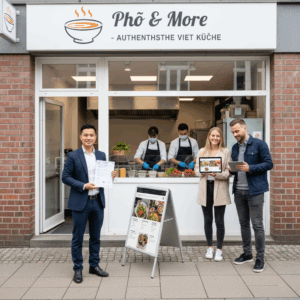
Case Study: Vietnamese Restaurant Chain in Germany
A Vietnamese restaurant chain in Berlin faced declining customers post-pandemic while staff and food costs increased. They implemented:
-
Online reservation and ordering system directly integrated with POS,
-
Targeted Facebook & Google Ads campaigns for German customers who enjoy Asian cuisine,
-
Automated loyalty programs via email and SMS,
-
Data analysis solutions to adjust menus and promotional hours.
Within six months, revenue increased by 28%, repeat customer rate rose by 35%, and labor costs decreased by 12% thanks to automation.
The Role of SPS Marketing
SPS Marketing understands businesses’ digital transformation needs and knows how modern communication is shifting strongly to social media platforms. Their services include:
-
Building professional websites with complete information such as services, prices, real images, and hygiene policies, allowing customers to trust the brand from the first visit.
-
Managing all social media channels, including content planning, posting, video creation, and maintaining engagement, ensuring the brand remains visible and polished.
-
Running targeted advertising campaigns aimed at the right audience, e.g., nearby customers aged 20–40 with an interest in beauty, saving costs while maximizing effectiveness.
As a result, your restaurant can not only “survive” challenging times but also actively attract customers and provide a premium experience.
Conclusion
Germany’s F&B industry is entering a new era where technology, data, and customer experience converge.
Businesses that apply technology practically, transparently, and effectively will not only survive but also lead the modern culinary trends. SPS Marketing serves as a bridge to help Vietnamese restaurant owners in Germany achieve this vision.