
Background: Changing Eating Habits of German Customers
After the pandemic, the eating habits of Germans have changed significantly. Previously, customers often chose to sit in restaurants to enjoy their meals and the ambiance. Today, they are increasingly cautious with spending. Many opt for time- and cost-saving solutions by ordering takeaway or home delivery.
According to Statista’s 2025 data, nearly 55% of customers in Germany order food online at least once a week, and this number continues to rise. This indicates that consumer trends have genuinely shifted toward convenience, speed, and flexibility.
For Vietnamese restaurants in Germany, this trend presents both opportunities and challenges. If restaurant owners continue marketing in the old way – using generic, “one-size-fits-all” promotions without distinguishing between dine-in and delivery customers – it will be difficult to attract the right audience and maintain stable revenue.
Understanding the differences between these two customer groups, as well as tailoring marketing strategies for each, is therefore crucial for Vietnamese restaurants to survive and grow sustainably in 2025–2026.
How Dine-in and Delivery Differ in Marketing
Effective marketing starts with understanding your customers – who they are, what they need, and what they expect. While dine-in and delivery customers come to the same brand, they differ in behavior, emotions, and the value they seek.
1. Differences in Customer Goals
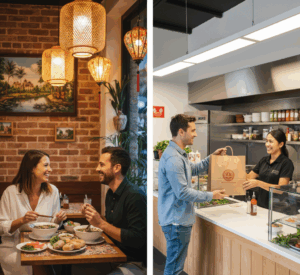
Dine-in customers visit a restaurant not only to eat but also to enjoy the overall experience. They want to savor their food in a cozy atmosphere, with soft music, suitable lighting, and attentive service. For them, dining is an emotional experience – relaxing, chatting with friends or family, and feeling the restaurant’s ambiance. They choose a restaurant not just for the food but for the feelings it evokes.
Delivery customers, on the other hand, have very different goals. They prioritize speed, convenience, and value. They do not care about the restaurant’s space or service but want tasty, clean food that is easy to take away and reliable. For them, “delicious and fast” is the top priority.
Because of these differences, marketing approaches must also differ.
- For dine-in customers, emphasize experience and emotions: a beautiful space, professional service, fresh ingredients, and the “authentic Vietnamese taste in the heart of Germany.”
- For delivery customers, focus on convenience, speed, and value: fast delivery, hygienic packaging, competitive pricing, and easy ordering.
2. Differences in Marketing Channels
Dine-in customers often find restaurants via Google Maps, Tripadvisor, Facebook, or Instagram. They read reviews, look at images of the space, furniture, and menus, and consider the overall impression before deciding to visit. Their key concerns are:
- “Is the space attractive?”
- “Are there comfortable seats?”
- “Are the staff friendly?”
Delivery customers, by contrast, search more pragmatically. They type queries like “best takeaway near me” on Google or check delivery apps such as Lieferando, Wolt, or Uber Eats, to view menus, food photos, and delivery times. What matters most to them is:
- “Is the food tasty?”
- “Is ordering easy?”
- “Is delivery fast?”
Marketing strategies must be optimized differently for each group:
- Dine-in: the website should include images of the restaurant space, detailed menus, customer reviews, and online table booking options.
- Delivery: the website or social media page should provide a simplified menu, a fast-order button, direct links to delivery apps, and clear messages like “Order in just 1 minute.”
3. Differences in Marketing Messages
The language and emotions that resonate with the two groups are completely different.
Dine-in customers respond well to emotionally engaging messages such as:
- “A cozy space, authentic Vietnamese taste in the heart of Germany.”
- “Attentive service, fresh ingredients every day.”
- “Enjoy a meal with family on the weekend.”
Delivery customers are attracted by messages emphasizing convenience and speed:
- “Quick order – delivered in 10 minutes.”
- “Convenient – tasty – hygienic – affordable.”
- “Fast lunch, authentic Vietnamese taste.”
It’s the same food, but knowing how to communicate the right message for the specific needs and emotions of each customer group can significantly enhance marketing effectiveness.
4. Differences in Visuals and Content
Another critical factor is imagery.
Dine-in visuals should evoke emotions and convey the experience. Use warm photos showing soft lighting, well-set tables, smiling customers, or attentive staff. Short videos could capture customers enjoying meals, the gentle clinking of dishes, or a couple dining. The goal is to make viewers want to visit the restaurant.
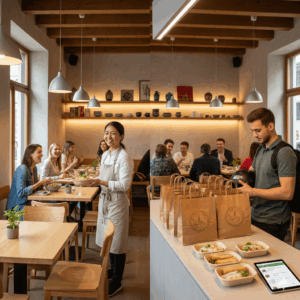
Delivery visuals, in contrast, should highlight convenience and hygiene. Photos of neatly packed meals, attractive packaging, friendly delivery staff, or the food being delivered directly to the customer are ideal. Videos could show fast packaging processes or meals arriving hot. The goal is to make customers feel that takeaway food is still delicious and reliable.
5. Differences in Post-Purchase Experience
The distinction extends beyond pre-purchase marketing to post-purchase experience.
- Dine-in customers evaluate restaurants based on food quality, service attitude, and comfort while dining. Friendly staff, well-presented dishes, and a pleasant atmosphere encourage repeat visits.
- Delivery customers assess based on delivery speed, food temperature, and packaging cleanliness and convenience. A smooth experience ensures they remember the restaurant and order again.
Restaurants should tailor post-purchase engagement for each group:
- For delivery customers, send thank-you messages with discount codes for their next order.
- For dine-in customers, encourage Google reviews or offer loyalty promotions like “Eat 5 times – get 1 free small dish.”
Small gestures like these significantly increase customer retention.
6. Customer Data – The Key Factor
Successful restaurants not only know how to cook but also how to analyze customer data.
- Dine-in customers usually provide contact details when booking: email, phone number, or Google reviews. These can be used to send tailored offers, e.g., “10% off online table booking” or “Weekend special for loyal customers.”
- Delivery customers provide data through delivery apps or online orders, which can be used to send promotions such as “Lunch combo deal for online orders only.”
Properly aggregated and utilized, this data allows restaurants to analyze revenue and identify which group is more profitable, enabling smarter and more cost-effective marketing investments.
Common Mistakes of Many Restaurant Owners
Many Vietnamese restaurant owners in Germany still use a “one-size-fits-all” approach. They post the same image or article for both dine-in and delivery customers. They do not track customer data, nor know which segment brings more profit. Their websites or Google Business listings are outdated, unclear about takeaway services, and do not reflect changes in opening hours.
Additionally, they often neglect post-purchase engagement: no thank-you messages, no review requests, and no incentive for repeat visits.
As a result, even expensive advertising campaigns perform poorly. Customers see the ads but forget the brand and do not feel valued.
Benefits of Separating Dine-in and Delivery Marketing
When you clearly understand the differences between these two groups and develop distinct marketing strategies:
- Revenue becomes more stable because you focus on the most profitable customers.
- Advertising costs become more effective, as messages, visuals, and channels are optimized for specific targets.
- Customer return rates increase because they feel understood and well-served.
- The brand appears more professional, as customers perceive that you understand and care for them.
Practical Example: Vietnamese Pho Restaurant in Berlin
A small Vietnamese pho restaurant in Berlin struggled post-pandemic. Dine-in customers dropped by more than 30%, while takeaway orders were inconsistent. After changing marketing strategies:
- Redesigned the website with two clear sections: “Dine-in” and “Delivery.”
- Ran separate Facebook Ads campaigns for each customer group.
- Optimized the takeaway menu with professional packaging images and affordable lunch combos.
- Encouraged dine-in customers to book online with small discounts.
Results after 2 months:
- Takeaway orders increased by 40%.
- Overall revenue increased by 25%.
- Repeat customers grew due to personalized experiences.
Role of SPS Marketing
At SPS Marketing, we understand the challenges faced by Vietnamese restaurant owners in Germany – managing operations while adapting marketing in a rapidly changing market.
We help create not only beautiful websites but also clearly separate marketing strategies for Dine-in and Delivery:
- Mobile-friendly websites with distinct interfaces for each group.
- Social media management with consistent visuals and clear messaging.
- Comprehensive ad campaigns targeting the right audience to boost orders.
- Customer data tracking, campaign optimization, and loyalty programs.
Conclusion
Dine-in and Delivery differ not only in service but also in marketing, communication, and customer care. In a context of rising costs and increasingly selective German customers, only restaurants that analyze customer behavior and market appropriately can maintain stable revenue.
If you operate a Vietnamese restaurant in Germany, review your current marketing: Are you sending the same message to two completely different groups?
An effective marketing strategy does not need to be complicated – it simply needs to reach the right audience – with the right message – at the right time. SPS Marketing is ready to help you achieve this.